
MESSAGE FROM DR. WRIGHT
Dear Neighbors, Partners, and Friends,
For more than thirty years, I have watched the same story play out in Black and low-income communities across this country. A facility nobody asked for shows up at the edge of a neighborhood. The paperwork is filed quietly. The hearing is scheduled for a weekday afternoon. By the time families learn what is coming, they are told the decision has already been made.
Today, that story is being told again with data centers. These facilities need enormous amounts of electricity and water, and developers often look for land where they expect the least resistance. Too often, that means our neighborhoods. More and more, it also means rural towns and farmland, where families may not hear about a project until it is already approved.
In New Orleans East, residents refused to let the story repeat. They organized, spoke up, and filled the room, and the City Council listened. In Memphis and in rural South Carolina, communities did the same. Their wins show what is possible when people know the process and show up together.
The question I keep coming back to is the same one I carry into every room: Who gets protected, and who gets left to prove they deserve it?
We built this toolkit so you do not have to start from scratch. Here you will find plain answers to common questions, a way to find the officials who decide, posts you can share tonight, handouts you can print for your block, and lessons from communities who have walked this road before us.
Our communities have always known what is happening to them. Now we are pairing that lived experience with data, with process, and with each other. Use these tools. Share them. And keep showing up. We’ve built resources of our own, and collaborated with partners to create a robust set of tools for you and your community. Everything here is free for your use. Please utilize this toolkit to protect your community from unwanted data center projects.
We stand with you and enough is enough.
In solidarity,


5 Things you can do right now:
1. Read our Data Center Frequently Asked Questions (FAQs) to learn what data centers are, who decides where they go and how to give public comment.
2. Find your representatives with the lookup tool, and save their phone numbers and emails in your phone.
3. Print the Starter Questions handout and bring it to your next neighborhood, church or community meeting.
4. Share one social media post, or send the neighbor message to someone on your block.
5. Read one case study to see how communities like yours stopped a data center, then pass the toolkit along.
FREQUENTLY ASKED QUESTIONS ABOUT DATA CENTERS
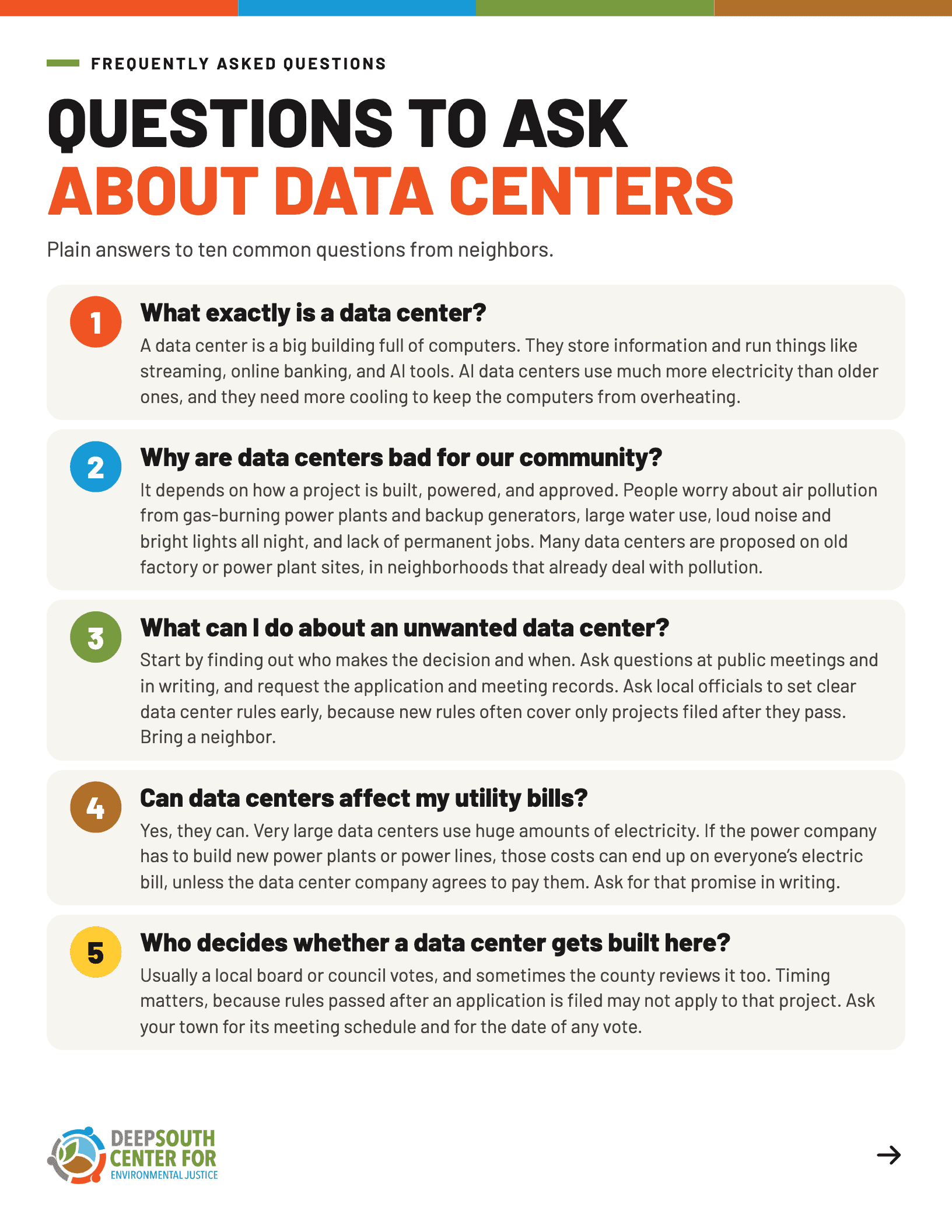
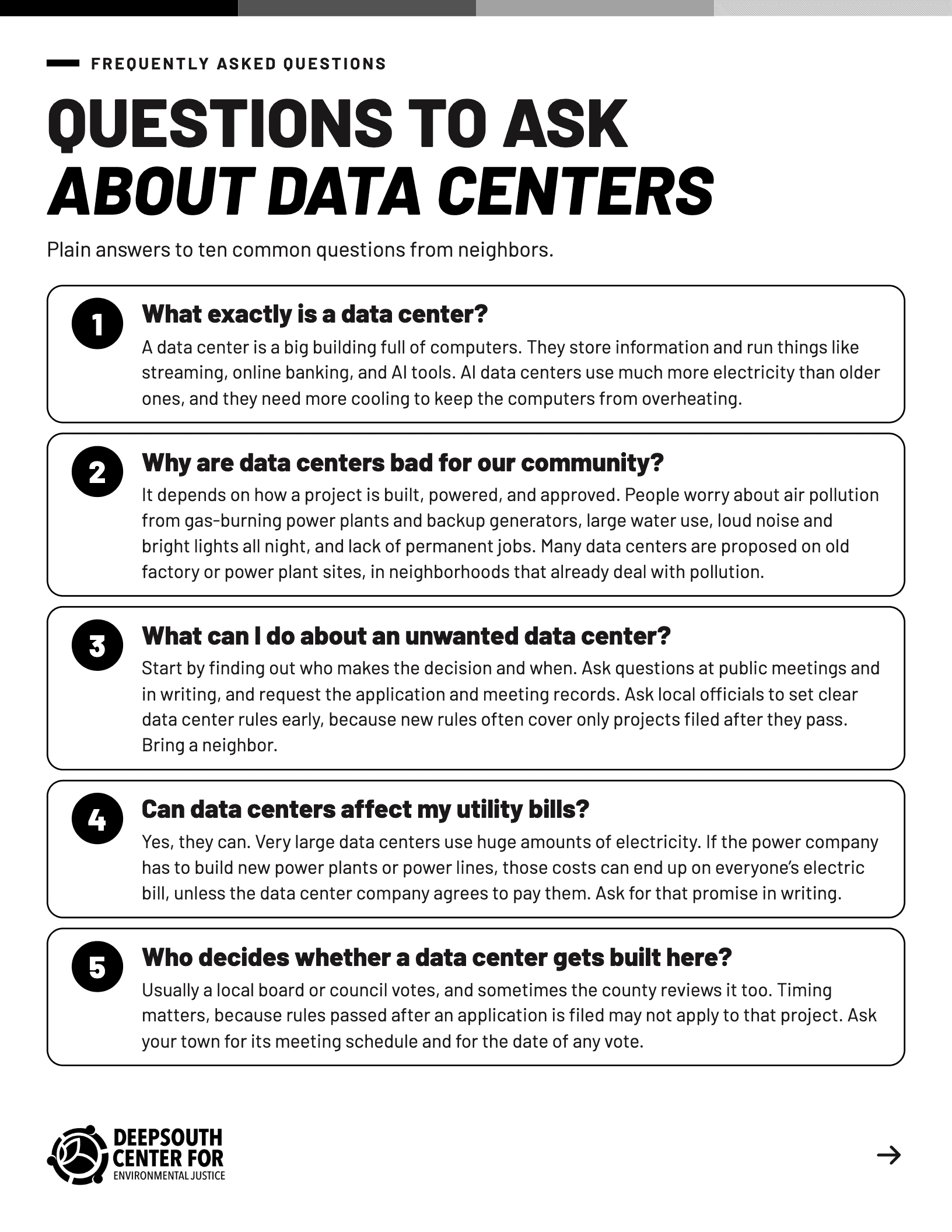
What is a data center?
A data center is a building full of computer servers that store and process information for websites, apps, and artificial intelligence. The largest ones, often called “hyperscale” data centers, can use as much electricity as a small city and large amounts of water for cooling.
Why should my community care?
When a data center is proposed near homes, residents have real reasons to ask about power bills, water supply, noise, light, traffic, and backup generators or gas plants that burn fuel nearby. Black and low-income neighborhoods already carry more than their share of pollution, so new burdens add up fast. Rural communities face added risks, including the loss of farmland and wells, and projects that move forward with little public notice.
Who decides whether a data center gets built?
It depends on where you live, but most decisions start locally. A city council, county commission, or township board usually votes on zoning. A planning or zoning commission often reviews the project first and makes a recommendation. State agencies handle air and water permits, and state utility regulators decide who pays for new power lines and plants.
What does “rezoning” or “conditional use” mean?
Rezoning changes what is allowed on a piece of land, such as switching it from residential or farmland to industrial. A conditional use means a facility is not allowed automatically. The developer must apply, the public gets a hearing, and officials can deny the project or attach conditions. These hearings are some of the most important moments for residents to be heard.
How do I give public comment?
You can usually speak in person at planning and council meetings or send written comments ahead of time. Check your local government’s website for comment forms and deadlines. Comments sent to public bodies are generally public records. Tips for strong comments:
- Say your name, your neighborhood, and how long you have lived there.
- Name the specific agenda item or case number.
- Share one personal concern and one clear request, such as “deny this rezoning” or “require a buffer of at least 1,000 feet from homes.”
- Keep it short. Two minutes goes fast.
What questions should I ask officials and developers?
Start here, and you’ll find a printable list below in the Handouts section:
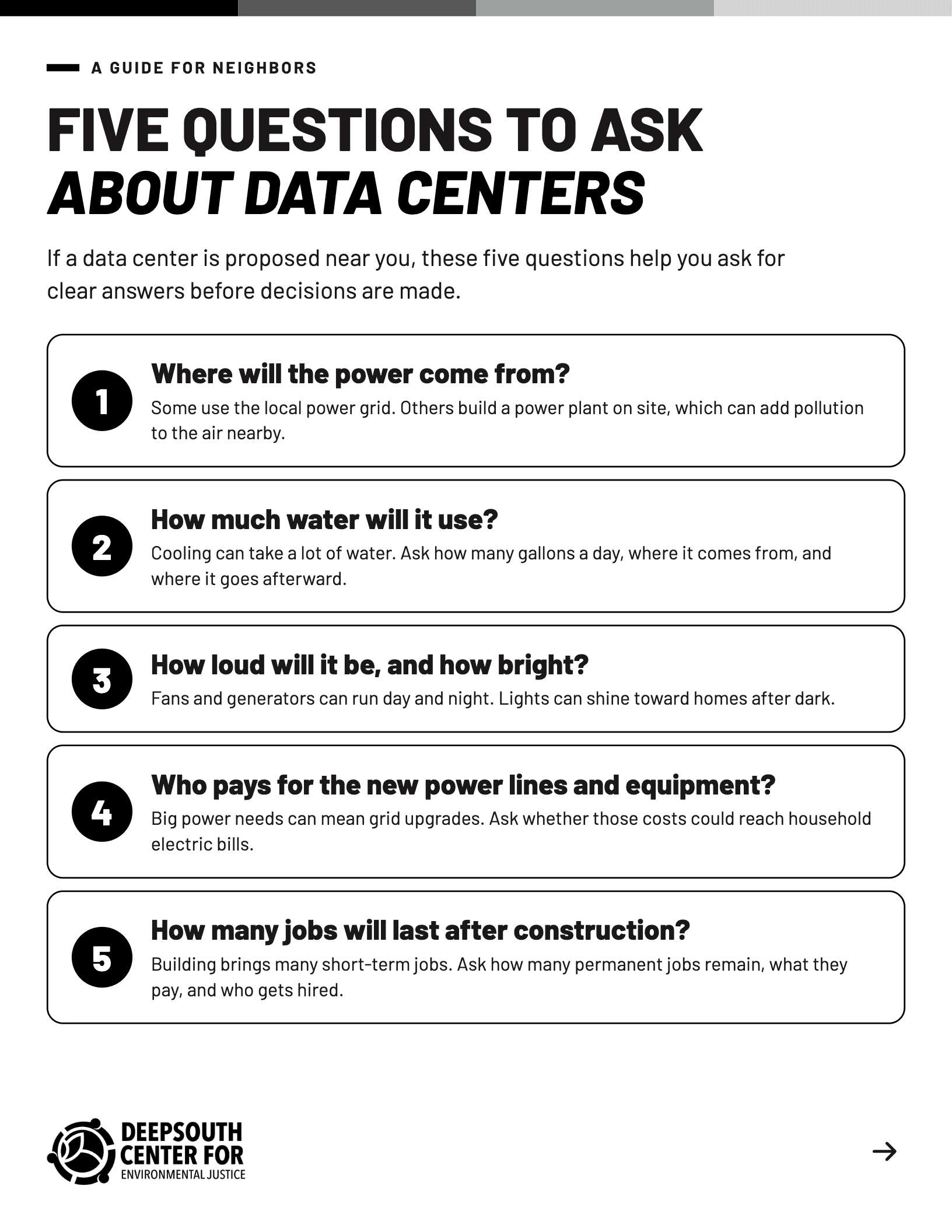
- How much electricity will this facility use, and who pays for new power lines or plants?
- How much water will it use each day, and where will that water come from?
- Will there be backup generators or an on-site power plant? What fuel will they burn?
- How close will the building be to the nearest home, school, church, or well?
- What will neighbors hear and see, day and night, and who will monitor it?
- How many permanent local jobs will this create, and will local residents be hired first?
- Is a community benefits agreement on the table, and how will it be enforced?
- Has anyone studied the total pollution this community already carries?
Can I request public records?
Yes, every state has a public records law, and the federal Freedom of Information Act covers federal agencies. You can ask for permit applications, utility agreements, emails, and meeting materials. Be specific about what you want and the date range. In Memphis, a public records request helped show that gas turbines powering a data center were running without permits.
WHO MAKES DECISIONS
- Mayor or top county official
- City council, county commission, or township board
- Planning or zoning commission
- State legislators
- Your state environmental agency, for air and water permits
- Your state utility commission, for power rates and new plants
- U.S. Representative and U.S. Senators
Use USA.gov: Find and Contact Elected Officials.
Don’t know what to say?
Just fill in the blanks below to help you speak with your representative:
Hello, my name is [Name], and I live in [neighborhood or ZIP code]. I’m contacting you about the proposed data center at [location]. I’m asking [Official] to [deny the rezoning / require a public hearing / support a buffer of at least 1,000 feet from homes]. Can you tell me where [Official] stands? Thank you.
SOCIAL MEDIA TEMPLATES
Use your online platforms and social media accounts to share the message and call your neighbors to action. There are 11 images in this kit that can be posted alone, or as a carousel post on any platform.
Social Post Templates
You can add your own logos or change these images however you want to support your community.
|
|
|
|
|
|


Caption Templates
Copy, paste, and post these starters! Insert your community, your logo, or your own words and don’t forget to tag @DSCEJNOLA so we can share your message.
Suggested hashtags: #EnvironmentalJustice #DataCenterDefense #ProtectOurCommunities
Ask the hard questions
Before anyone builds a data center near our homes, we deserve answers. How much power? How much water? How close to our schools? Who pays when bills go up? Get DSCEJ’s free Starter Questions: dscej.org
Show up
Decisions about our communities are made in rooms we’re expected to stay out of. Not this time. The next meeting on the proposed data center is [DATE] at [TIME], [LOCATION]. Come with us. Bring a neighbor.
We’re not alone
From New Orleans to South Memphis to rural South Carolina, Black communities are standing up to data centers, and winning. Learn from their fights: dscej.org
Newsletter, Text, or Website Blurb:
Hey [Name], have you heard about the data center they want to build near us? It could affect our power bills, water, and quiet streets. DSCEJ has free resources with easy steps to help us fight at www.dscej.org/. Our next [ governing body] meeting is [date].
PRINTABLE HANDOUTS
Free handouts for church bulletins, neighborhood meetings, community centers, and front porches. Each one prints on standard letter-size paper. You CAN print these in black and white.
Print it. Post it. Pass it on.
 5 Questions About Data Centers Handout [Color] [Black & White] |
 10 FAQs About Data Centers [Color] [Black & White] |
RESOURCES FROM OTHER CITIES
You are not fighting this issue alone. Environmental justice has always been built by communities sharing what works. Use these resources, adapt them, and credit the people who created them.
- When Will the Taps Run Dry? Community Protection Toolkit: Starter questions and everyday actions for communities facing large data centers and their water demands.
- Inside Memphis’ Fight Against xAI (Southern Environmental Law Center): A timeline of how residents and legal partners used public records, aerial imaging, testimony, and the Clean Air Act to challenge unpermitted turbines powering a data center.
- Data Center Watch: Research tracking local opposition to data centers nationwide.
- USA.gov: Find and Contact Elected Officials
Know of a resource we should add?
Email us at media@dscej.org
STORIES FROM OTHER CITIES
These stories are proof that organized communities change outcomes when they fight data centers together. Every fight is different, but these lessons can help:
New Orleans East | A Neighborhood Says “Enough”
In early 2026, a developer sought to rezone residential lots in New Orleans East for a data center. For decades, this highly educated, economically viable Black community has been targeted for facilities other parts of the city would never accept. Residents, neighborhood leaders, and DSCEJ spoke out quickly and publicly. On January 28, 2026, the City Council voted unanimously for a one-year, citywide pause on data centers and directed planners to write permanent rules.
The Lesson: Speed and visibility matter. Speaking up early can stop a project in its tracks. Winning a pause is only the first step; permanent rules are where lasting protection is won.
South Memphis, Tennessee | Holding Officials Accountable
In 2024, xAI began running methane gas turbines to power a supercomputer in South Memphis, a historically Black community already burdened by industrial pollution. When residents noticed the turbines, the Southern Environmental Law Center filed a public records request and found no permits. Partners used aerial and thermal imaging to show the turbines were running. Hundreds of residents testified at public hearings, and the NAACP later filed a Clean Air Act lawsuit.
The Lesson: Document everything. Public records, photos, and independent data can prove what residents already know.
Colleton County, South Carolina | Neighbors Protecting Their Land
After a majority-white county in Georgia blocked a data center, the same developer proposed an 800-acre project in rural Colleton County, where the share of Black residents is nearly twice as high. The site sat in the ACE Basin, near homes, a church, and important waterways. For nine months, the Rev. Edward Moultrie and members of St. Paul CME Church filled county meetings. Residents sued the county over a zoning change that would have allowed data centers in rural areas. In October 2026, a settlement created a “Data Center Exclusion Area” that bans data centers across most of the ACE Basin in the county, including the proposed site.
The Lesson: Faith communities and longtime landowners are powerful voices. Steady presence at meetings, backed by legal action, can protect a whole region, not just one site.
Help Us Continue to Fight
For decades, we’ve been fighting for fenceline communities. This work is even more critical today, now that we face the cumulative impacts of climate change, petrochemical facilities, and data centers in our back yards. Your donation helps us support communities nationwide who are disproportionately impacted by environmental harms.